🇬🇧 English
🇬🇧 English
Тёмная тема
The neural employee can assist businesses in communicating with people in different languages.
For an entrepreneur, this is a strong opportunity: an operator or business owner can write in a language comfortable for them, while the neural employee adapts the response to the language of the audience. The client receives the message in a way that is easier for them to understand, and the team does not face a language barrier.
Many companies lose applications not because the product is bad, but because the client finds it inconvenient to read, ask, or buy in a foreign language.
The neural employee helps to:
This is especially useful for Telegram bots, online consultations, support, sales, training, and digital products.
In most cases, the language can be determined from the client's message itself.
If a person writes in English, Ukrainian, Spanish, or another language, the neural employee can continue the dialogue in that language.
In some channels, it is also possible to obtain a technical hint: for example, the language of the device, interface, or user account. This helps to understand which language is likely more comfortable for the person to perceive content in.
In Telegram, the user can also choose or change the language using the command:
/langAfter the command, the language selection appears: the current language and a list of options with flags.
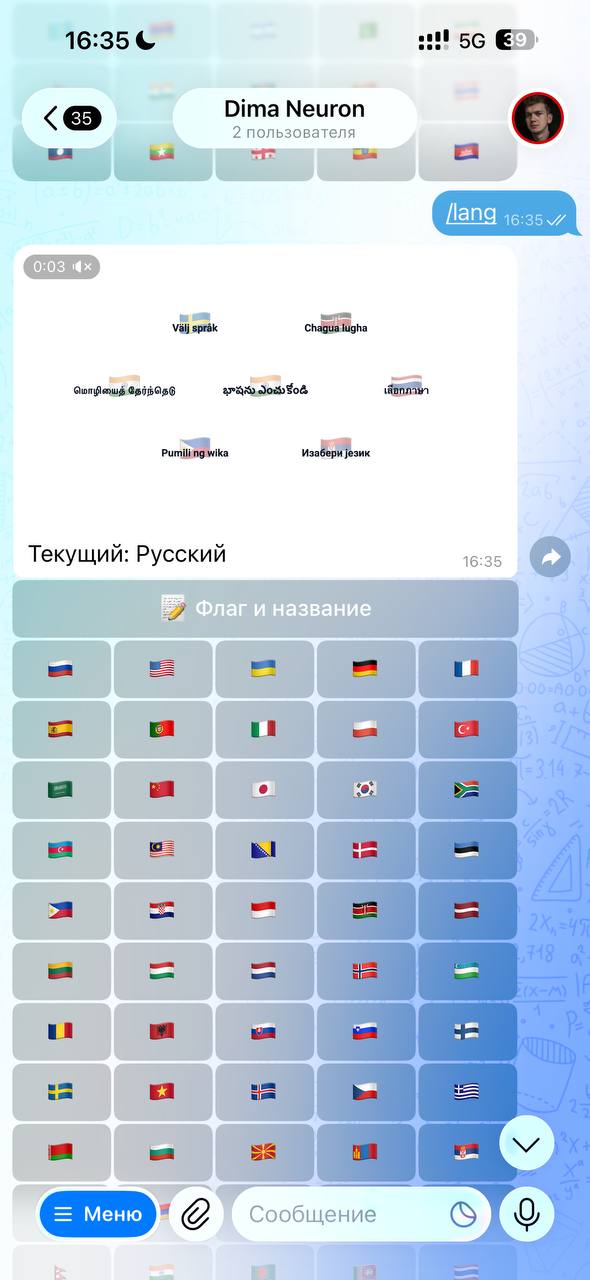
But an important rule is simple: if in doubt, it's better to clarify with the client which language they prefer to continue in.
The neural employee's operator does not need to know the language of every client.
For example:
Thus, the neural employee works as a language bridge between the business and the audience.
This is not just a literal translation. A good setup takes into account:
For businesses, it's important to understand: "language" is not just Russian, English, Ukrainian, or Spanish.
In real communication, the following matter:
The same meaning can be explained differently: to an entrepreneur, a novice, a technical specialist, a teenage audience, or someone who is not well acquainted with the topic.
Therefore, the neural employee can not only translate but also adapt the response for the audience.
Modern neural networks know a vast number of languages: widespread modern languages, rare languages, and many historical languages that were once used by people.
For public description, it is better to state this honestly: the neural employee can work with a very wide range of languages, and for rare, ancient, or specialized languages, quality must be verified with real examples.
In typical business scenarios, this is enough to cover most tasks: consultations, support, sales, content, and translation of communication between the operator and the client.
Clients write in different languages, and the neural employee responds to each in an understandable form and relays complex cases to the manager.
The same product can be explained to different audiences without a separate website for each language at the initial stage.
The operator provides meaning in a comfortable language, while the neural employee prepares versions of the post, message, or instruction for different languages.
The client writes in a foreign language, while the owner receives a brief summary in their language and can make a decision.
To ensure multilingualism works safely, it is necessary to determine:
/lang;It is especially important not to translate prices, guarantees, terms, and promises "by meaning" if they are not documented in the knowledge base. In such matters, the neural employee should rely on approved materials or transfer the matter to a person.
The neural employee can become a translator between the business and the audience.
The operator communicates in a language comfortable for them, the client receives a response in a language that is easier for them to understand, and the business can operate more widely without a separate language team at each start.
Find out which roles of neural employees can work multilingual and see the overview of capabilities.
In Telegram, the client can choose the language themselves using the command /lang, and the setup can consider not only the language but also dialect, communication style, and the complexity level of the explanation.
This is especially convenient for widely spoken languages. For rare and historical languages, quality is better verified with examples, but the very ability for multilingual communication remains one of the strong features of neural employees.