🇬🇧 English
🇬🇧 English
Тёмная тема
Vacation Planner AI is an example of a neuro consultant in the travel niche. Its task is to help individuals plan their vacation: understanding desires, selecting a destination, explaining accommodation options, and showing where savings can be made.
Such a consultant does not operate like an ordinary chatbot with buttons but as a digital assistant that engages in dialogue and relies on a knowledge base of travel products.
At the start, the bot immediately presents itself as a vacation planning assistant: explaining how it can be useful and guiding the user to the first action.
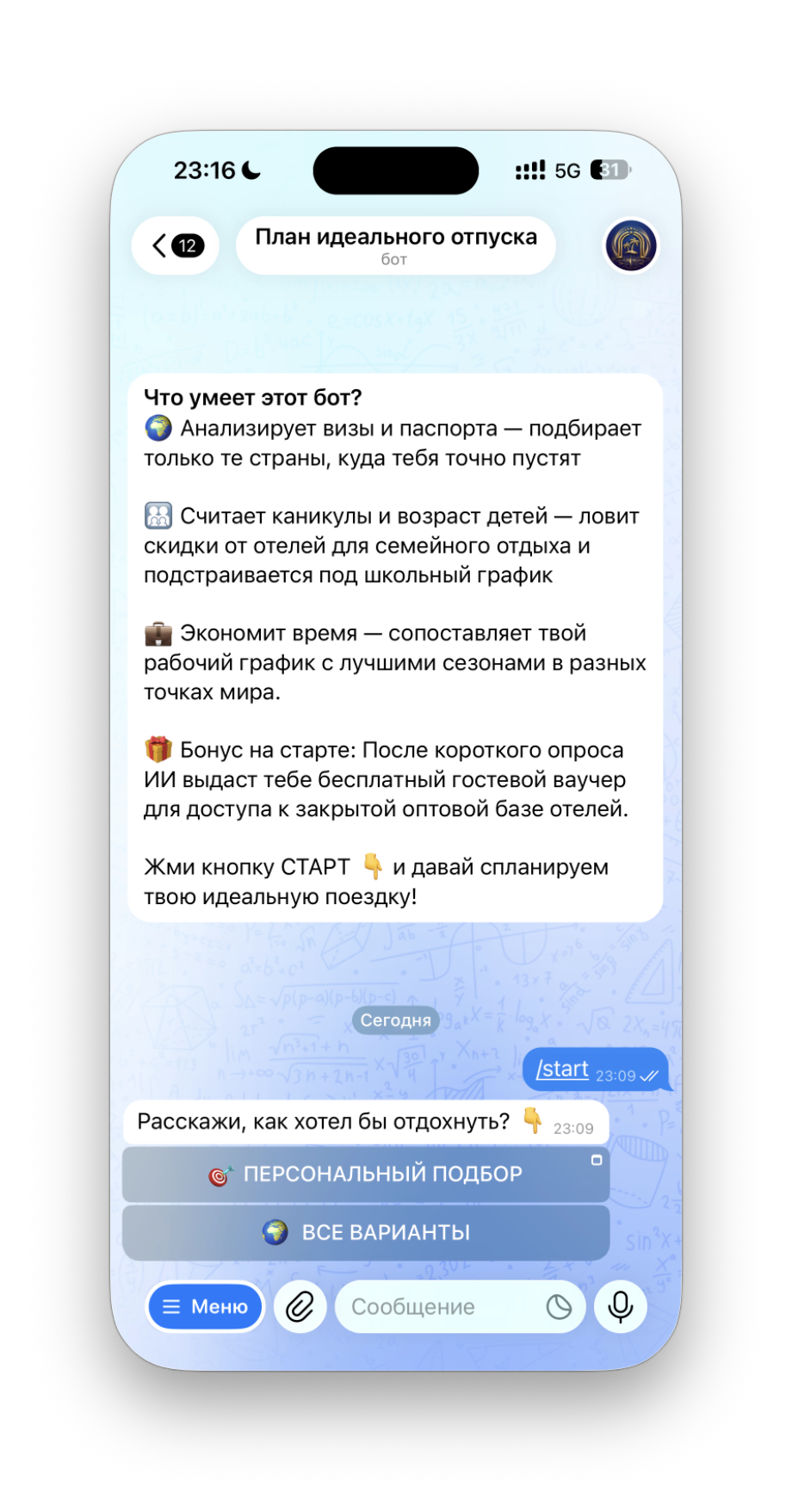
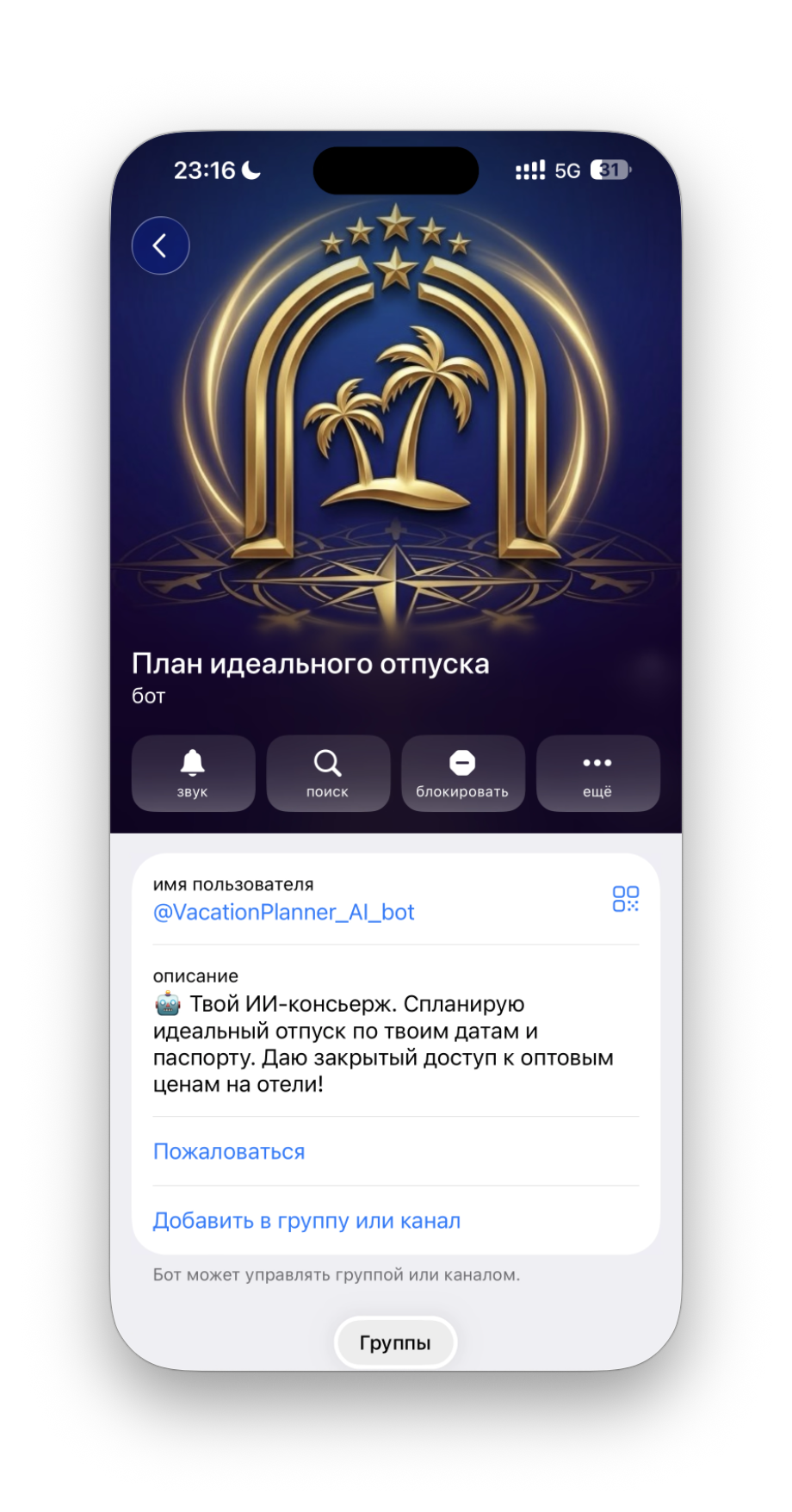
The main feature of Vacation Planner AI is that it helps the interlocutor gather an idea of the perfect vacation.
A person may come without a precise plan:
The neuro consultant clarifies the inputs, explains options in simple terms, and helps the individual narrow down their choices. Instead of examining dozens of websites, the client receives an interlocutor who guides them through the decision-making process.
At the core of such a consultant is a knowledge base about the travel service Travel Advantage and its capabilities.
According to the database, the product includes:
For the client, this is important not as dry statistics but as a sense of choice: the consultant can explain what opportunities are available within the system and which scenario fits a specific trip.
The neuro consultant can explain the product's economics in simple terms.
For example:
Importantly, the neuro consultant should not promise the same discount to everyone. Its task is to explain the mechanics and help verify a specific option.
In travel products, individuals often struggle to understand where genuine savings are and where marketing jargon prevails.
The neuro consultant helps organize this information:
In this way, the client doesn't just see numbers but understands how to use them.
A second strong feature of Vacation Planner AI is the use of forms.
The form aids in avoiding blind selections. The neuro consultant can preliminarily clarify important input from potential clients:
After this, the neuro consultant receives not just a message saying "I want a vacation," but a clear profile of the client. It can analyze the answers, ask for clarifications, and search for the most advantageous travel offer for the specific situation.
For the travel niche, this is especially important: a great offer depends not just on the destination but also on the country of residence, citizenship, dates, currency, trip composition, preferences, and available booking conditions.
The form turns the dialogue into a more precise scenario:
Thus, the manager or partner receives not a chaotic correspondence but a prepared request: who the client is, where they are from, what they are looking for, what limitations exist, and where savings can be sought.
Vacation Planner AI demonstrates the strong side of a neuro consultant: it connects a large knowledge base with a live human request.
The travel service has many details: destinations, hotels, currencies, subscriptions, credits, access levels, price guarantees, guest passes. If all this is presented to a person as a dry list, they can get confused.
The neuro consultant transforms a complex system into dialogue:
In tourism, one cannot promise a fixed discount in advance.
Prices depend on:
Therefore, the correct role of the neuro consultant is not to "guarantee the cheapest vacation," but to help an individual quickly understand, verify options, and make a decision based on current data.
Vacation Planner AI is an example of a neuro consultant that helps not only answer FAQs but also accompanies a person in their choices.
It knows the product, explains the conditions in simple terms, asks clarifying questions, and helps the interlocutor get closer to a decision: where to go, which format of vacation to choose, and how to take advantage of the service's offerings.
This is a good example of how a neuro consultant becomes a guide between a complex product and an ordinary client.